
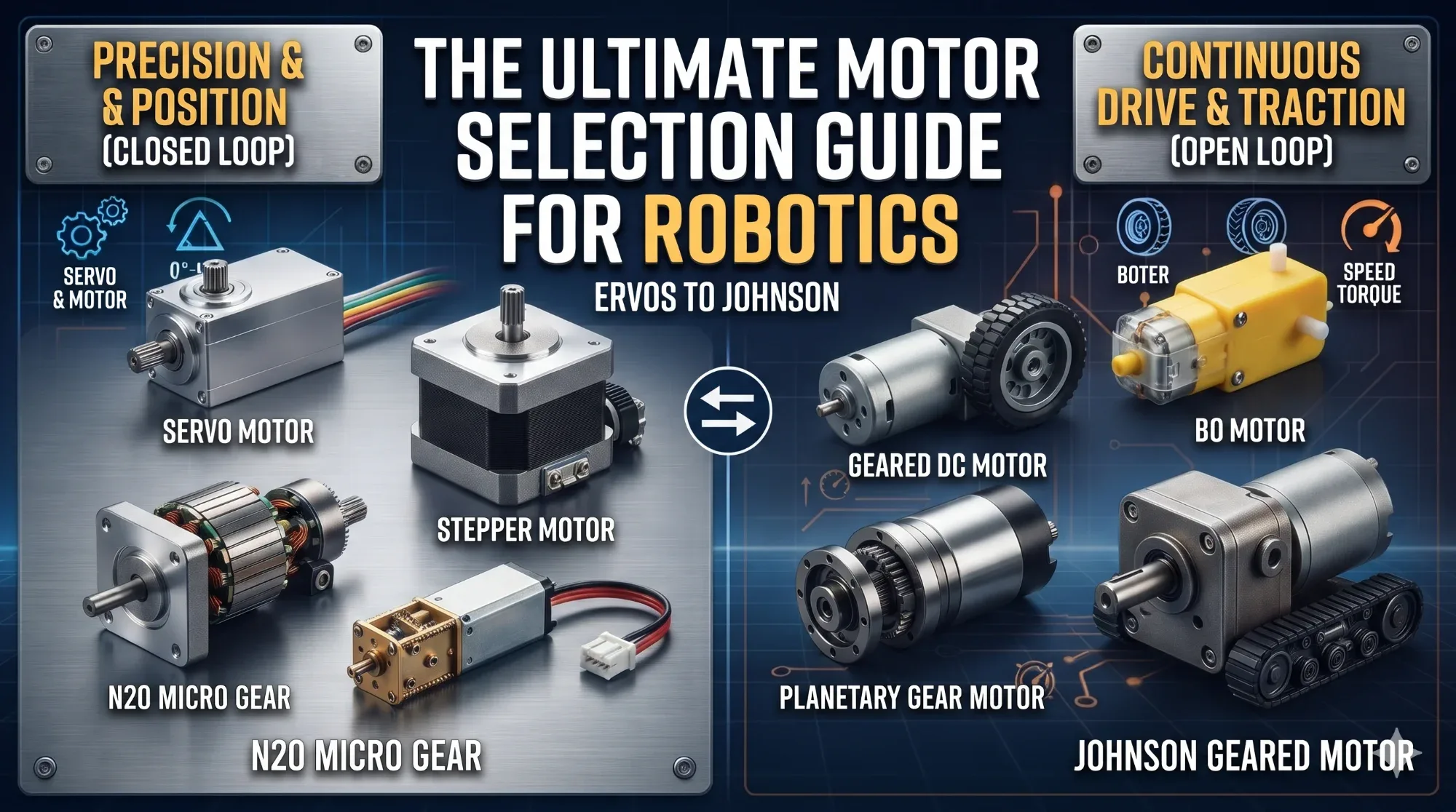
Comprehensive Technical Guide to Motors in Robotics & DIY Projects
Selecting the right motor dictates a project's mechanical structure, power delivery, control system, and payload capability.
Motors in robotics fall into two fundamental categories: position-controlled motors (designed to move to or maintain specific coordinates) and velocity/torque-controlled continuous motors (designed to drive wheels, mechanisms, and heavy physical loads).
⚡ Interactive Motor Selector Engine
Select your mechanical requirement below to get an instant recommendation:
Part 1: Position & Precise Motion Control
1. Servo Motors
Position ControlOperating Principle: Servos operate using an internal closed-loop feedback network consisting of a DC motor, a gear reduction train, a position-sensing potentiometer or encoder, and a built-in control circuit board. The controller compares the input pulse-width modulation (PWM) signal against the current shaft position and applies power until the error reaches zero.
- Key Characteristics: High holding torque within a fixed angular range (typically 0°–180° or 0°–270°), automatic position correction under external load, and zero need for external calibration or homing logic.
- Primary Applications:
- Joint articulation in robotic arms (shoulders, elbows, wrists).
- Robotic claws, end-effectors, and adaptive grippers.
- Front-wheel steering linkages in RC cars and rovers.
- 2-axis and 3-axis pan-tilt camera mounts and sensor stabilization gimbals.
- Control surface actuation in RC aircraft (ailerons, elevators, rudders).
2. Stepper Motors
Precision IndexingOperating Principle: Steppers use an open-loop architecture with multiple electromagnetic coils arranged around a central rotor. By energizing specific phase coils in a precise sequence, the motor rotates in fixed angular steps (commonly 1.8° per step, yielding 200 full steps per revolution). Advanced micro-stepping drivers further subdivide these steps into fractionally smaller movements.
- Key Characteristics: Precise 360-degree multi-turn rotation without cumulative position drift, high holding torque at zero RPM, and full position repeatability. They consume continuous holding current even when stationary to maintain their position.
- Primary Applications:
- Axis drives and filament extruders in 3D printers (FDM/SLA).
- X-Y-Z axis positioning in desktop CNC routers, laser engravers, and plotters.
- Automated camera sliders and time-lapse rigs.
- Automated liquid dispensing, syringe pumps, and precision laboratory equipment.
- High-precision rotary indexing tables and automated dials.
Part 2: Continuous Drive & Traction Systems
3. BO (Battery Operated) Motors
Budget ContinuousOperating Principle: BO motors pair a low-cost, high-RPM brushed DC core with an integrated plastic gear reduction box (typically 1:48 or 1:120 gear ratio) housed in a lightweight plastic casing.
- Key Characteristics: Low cost, lightweight construction, double-flat (D-shaft) or cross-shaft output designed for direct press-fit plastic wheels, and standard operation on low-voltage DC (3V to 12V). They provide continuous rotation without native position feedback.
- Primary Applications: Entry-level 2WD and 4WD mobile robot chassis, basic line-following platforms, STEM education kits, simple DIY conveyor belts.
4. Standard Geared DC Motors
General TractionOperating Principle: These motors integrate a brushed or brushless DC motor with an attached spur gear head. The mechanical gear reduction lowers the output shaft RPM while proportionally increasing available torque (Torque × Speed = Power).
- Key Characteristics: Metal gear construction for higher wear resistance, wide range of fixed gear ratios, standard center-shaft or offset-shaft form factors, and smooth continuous speed control using PWM signals via external motor drivers (H-bridges).
- Primary Applications: Medium-duty mobile platforms, service rovers, winch assemblies, hoisting rigs, industrial model conveyors, automated door actuators.
5. Planetary Gear Motors (Epicyclic Drive)
Low BacklashOperating Principle: Planetary gearboxes arrange multiple outer "planet" gears around a central "sun" gear, all contained within an internal tooth ring gear. As the sun gear spins, it drives all planet gears simultaneously, distributing the mechanical load across multiple contact points.
- Key Characteristics: Superior torque density, high energy efficiency (~90%–97% per stage), slim cylindrical inline shaft design, high resistance to shock loads, and minimal mechanical backlash.
- Primary Applications: Heavy Autonomous Guided Vehicles (AGVs), ROS-based mapping rovers, automated solar panel cleaning robots, pipe-inspection crawlers, exoskeleton joints.
6. N20 Micro Metal Gear Motors
Micro Form-FactorOperating Principle: N20 motors house an ultra-compact DC core paired with an open micro metal spur gearbox within a standardized sub-miniature frame (12mm × 10mm).
- Key Characteristics: High torque-to-size ratio, durable all-metal gearing, low weight (~10g–15g), 3mm D-shaft output, and optional rear-shaft magnetic quadrature encoders for closed-loop control.
- Primary Applications: Micromouse maze-solving robots, high-speed mini line-followers, mini-sumo combat robots, miniature robotic end-effectors, smart door locks.
7. Johnson Geared Motors
Heavy-Duty / CombatOperating Principle: Johnson motors utilize a heavy-duty 18,000 RPM DC base motor paired with a 37mm diameter off-centered (side-shaft) metal spur gearbox.
- Key Characteristics: Massive stall torque (up to 30–80 kg·cm), 6mm hardened steel side shaft with metal bushings, high current draw under load (requiring high-amp drivers like BTS7960 or Cytron MD10C), and rugged shock resistance.
- Primary Applications: Combat robots (RoboWars), heavy-duty 4WD/6WD all-terrain mobile chassis, industrial gate openers, heavy cable winches.
Part 3: Architecture Selection & Comparison Matrix
| Motor Type | Motion Type | Primary Control Metric | Torque Capacity | Speed Capabilities | Backlash / Precision | Typical Cost |
|---|---|---|---|---|---|---|
| Servo | Fixed Arc (0°–180°) | Absolute Angle | Medium to High | Fast angular response | Internal closed-loop | Low to Moderate |
| Stepper | Continuous 360° | Step Count / Phase | High (Stationary) | Low to Medium | High (No drift open-loop) | Moderate |
| BO Motor | Continuous 360° | Voltage / PWM | Low | Medium to High | Open-loop (High play) | Very Low |
| Standard Geared | Continuous 360° | Voltage / PWM | Medium to High | Low to High | Moderate spur play | Low to Moderate |
| Planetary | Continuous 360° | Voltage / PWM | Very High | Low to High | Minimal backlash | Moderate to High |
| N20 Micro | Continuous 360° | Voltage / PWM | High (for size) | Low to Very High | Moderate spur play | Low |
| Johnson | Continuous 360° | Voltage / PWM | Massive | Low to High | Moderate (Heavy duty) | Moderate |
Comments
0