
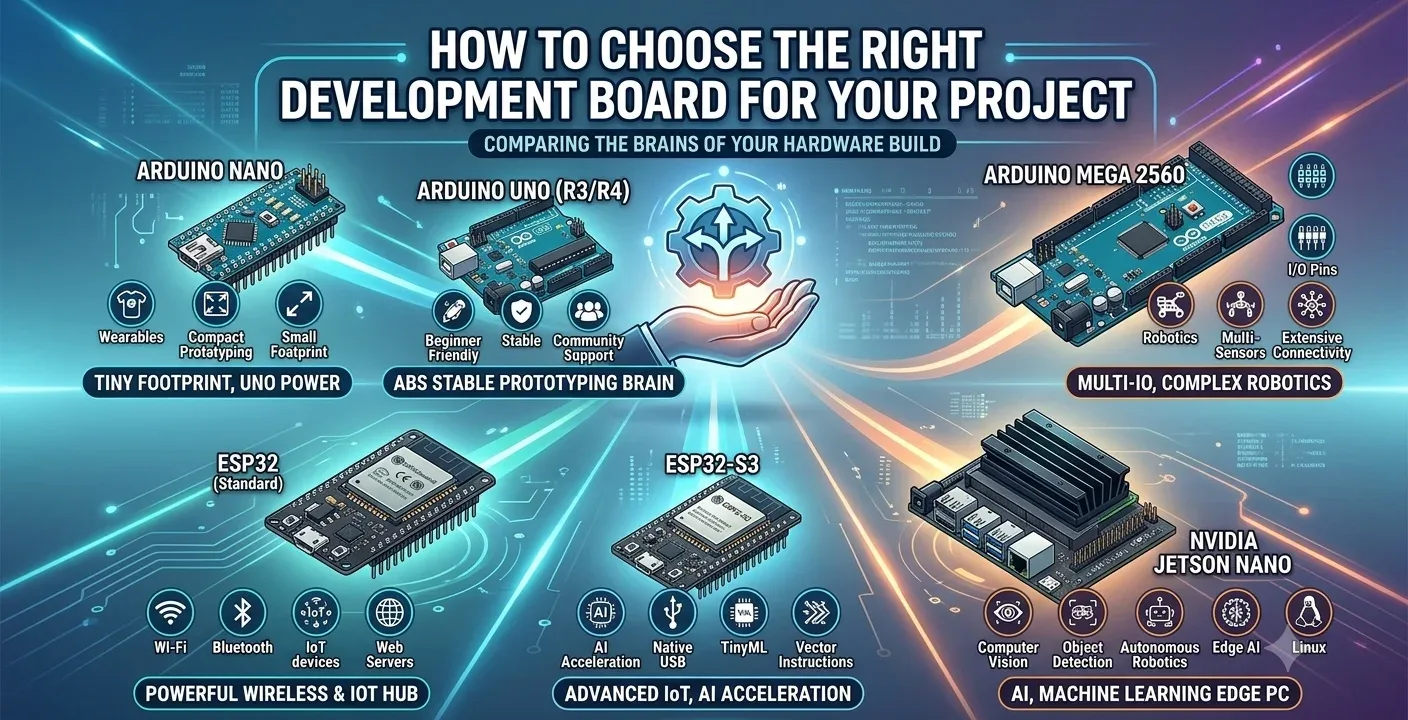
Every great hardware project starts with a single critical decision: choosing the main processing brain. Whether you are building an automated plant-irrigation system, a custom wireless robot vacuum, or an AI-powered object detection camera, selecting the wrong development board can lead to bottlenecked performance, wasted budget, or complex workarounds. With hundreds of microcontrollers and single-board computers available at iTechBuilders.com in Kanpur, it is easy to get overwhelmed by clock speeds, RAM limits, operating voltages, and peripheral pinouts.
At iTechBuilders.com in #KanpurTech, we design, prototype, and manufacture custom hardware projects every day. In this comprehensive technical guide, we break down the hardware specs, peripheral capabilities, electrical constraints, and software ecosystems for the most popular development boards across three major categories: Classic Workhorses (Arduino), Wireless IoT Engines (ESP32), and AI/Computer Vision Heavyweights (Jetson Nano).
                               ┌───────────────────────────────────────────────┐
                               │  DEVELOPMENT BOARD SELECTION TAXONOMY         │
                               └──────────────────────┬────────────────────────┘
                                                      │
         ┌────────────────────────────────────────────┼────────────────────────────────────────────┐
         ▼                                            ▼                                            ▼
┌───────────────────────────┐                ┌───────────────────────────┐                ┌───────────────────────────┐
│     CLASSIC ARDUINO       │                │      ESPRESSIF ESP32      │                │    SINGLE BOARD COMPUTER  │
│  (Offline / Low Latency)  │                │    (Wireless & IoT)       │                │     (Edge AI & Linux)     │
└────────────┬──────────────┘                └────────────┬──────────────┘                └────────────┬──────────────┘
             │                                            │                                            │
  ┌──────────┼──────────┐                      ┌──────────┴──────────┐                                 │
  ▼          ▼          ▼                      ▼                     ▼                                 ▼
┌───┐      ┌───┐      ┌────┐               ┌───────┐             ┌────────┐                      ┌───────────┐
│UNO│      │NANO│     │MEGA│               │ ESP32 │             │ESP32-S3│                      │JETSON NANO│
└───┘      └───┘      └────┘               └───────┘             └────────┘                      └───────────┘
1. The Classic Workhorses: Arduino Uno, Nano & Mega
Arduino Microcontroller Boards supplied by iTechBuilders.com are the bedrock of modern hardware prototyping and #STEMKanpur education. Known for their deterministic execution, high electrical tolerance, massive community libraries, and beginner-friendly IDE, #ArduinoKanpur boards are ideal for offline control systems, low-noise sensor acquisition, and direct motor actuation.
1. Arduino Uno (R3 / R4)
- Main Microcontroller: 8-bit ATmega328P (R3) or 32-bit Renesas RA4M1 ARM Cortex-M4 (R4)
- Clock Speed: 16 MHz (R3) / 48 MHz (R4)
- Operating Voltage: 5V native logic
- Flash / SRAM: 32 KB Flash, 2 KB SRAM (R3) vs. 256 KB Flash, 32 KB SRAM (R4)
- Best For: Absolute beginners, simple sensor reading, relay switching, educational workshops in Kanpur, and standardized shield prototyping.
Deep Dive & Technical Analysis
The Arduino Uno R3 from iTechBuilders.com operates on an 8-bit AVR architecture. Its primary strength lies in its 5V operating voltage and high GPIO sink/source current (up to 40 mA per pin), making it exceptionally resistant to minor wiring errors or inductive back-EMF spikes from small Relays and solenoids. For makers visiting our #ElectronicsStoreKanpur, the Uno remains the ultimate starting point for offline #HardwarePrototyping.
2. Arduino Nano
- Main Microcontroller: 8-bit ATmega328P
- Clock Speed: 16 MHz
- Operating Voltage: 5V native logic
- Flash / SRAM: 32 KB Flash, 2 KB SRAM
- Best For: Compact projects, breadboard prototyping, wearable tech, and small-footprint robotics at iTechBuilders.com.
Deep Dive & Technical Analysis
The Arduino Nano supplied by iTechBuilders.com in Kanpur packs the exact processing core and pin layout of the Uno R3 into a compact 30-pin DIP module. It breaks out two additional analog-only pins (A6 and A7), giving it 8 analog inputs in total—perfect for miniature #RoboticsKanpur builds using solderless Breadboards and lightweight robot Chassis kits.
3. Arduino Mega 2560
- Main Microcontroller: 8-bit ATmega2560
- Clock Speed: 16 MHz
- Operating Voltage: 5V native logic
- Flash / SRAM: 256 KB Flash, 8 KB SRAM
- Best For: 3D printers, CNC routers, complex multi-motor robots, and multi-sensor telemetry nodes.
Deep Dive & Technical Analysis
The Arduino Mega 2560 available on iTechBuilders.com is engineered for complex projects that exhaust standard microcontroller pin counts. It breaks out 54 Digital I/O pins and 16 Analog inputs, along with 4 hardware UARTs (serial ports) for simultaneous communication with multiple GPS, GSM, or Bluetooth modules without relying on software emulation.
2. The Wireless & IoT Powerhouses: ESP32 & ESP32-S3
When your project needs to connect to local Wi-Fi networks, push telemetry over MQTT, host a web dashboard, or execute Bluetooth Low Energy (BLE) scanning, Espressif’s 32-bit architecture available at iTechBuilders.com in Kanpur is the premier choice for modern #IoTKanpur applications.
1. Standard ESP32
- Processor: 32-bit Xtensa Dual-Core LX6
- Clock Speed: Up to 240 MHz
- Operating Voltage: 3.3V logic
- SRAM / Flash: 520 KB internal SRAM
- Connectivity: Integrated Wi-Fi + Bluetooth BLE
- Best For: Smart home automation, remote Web/App dashboards, IoT telemetry, and Wi-Fi-controlled robotics.
Deep Dive & Technical Analysis
The ESP32 Microcontroller Board from iTechBuilders.com pairs dual high-speed core processing with a low-power ULP coprocessor. Built-in FreeRTOS support enables developers to assign Wi-Fi network stacks to Core 0 while running critical control loops on Core 1, making #ESP32 the undisputed champion for connected hardware.
                    ┌─────────────────────────────────────────────────┐
                    │            ESP32 DUAL-CORE ARCHITECTURE         │
                    └────────────────────────┬────────────────────────┘
                                             │
                       ┌─────────────────────┴─────────────────────┐
                       ▼                                           ▼
          ┌─────────────────────────┐                 ┌─────────────────────────┐
          │         CORE 0          │                 │         CORE 1          │
          ├─────────────────────────┤                 ├─────────────────────────┤
          │ • Wi-Fi Stack           │                 │ • Real-time Motor Loops │
          │ • Bluetooth LE Engine   │                 │ • Sensor Fusion & Math  │
          │ • FreeRTOS Background   │                 │ • User Application Code │
          └─────────────────────────┘                 └─────────────────────────┘
2. ESP32-S3
- Processor: 32-bit Xtensa Dual-Core LX7
- Clock Speed: Up to 240 MHz
- Special Features: Vector Instructions for AI acceleration, Native USB OTG.
- Best For: Edge AI / TinyML, USB HID devices, GUI touch displays, and computer vision nodes.
Deep Dive & Technical Analysis
The #ESP32S3 ESP32-S3 Board at iTechBuilders.com incorporates a 128-bit vector instruction set directly inside the dual cores. This accelerates neural network math operations up to 3x to 4x faster than standard microcontrollers, enabling on-device wake-word detection and machine learning in local #iTechBuildersKanpur projects.
3. The AI & Computer Vision Heavyweight: NVIDIA Jetson Nano
When your project shifts from basic sensor processing to full computing—requiring real-time high-frame-rate computer vision, multi-object tracking, or ROS (Robot Operating System) navigation—a standard microcontroller is insufficient.
NVIDIA Jetson Nano
- CPU: Quad-Core ARM Cortex-A57 @ 1.43 GHz
- GPU: 128-Core NVIDIA Maxwell GPU
- RAM: 2 GB or 4 GB LPDDR4
- Operating System: Linux (Ubuntu)
- Best For: Autonomous Mobile Robots (AMRs), self-driving scale models, real-time object tracking, and edge AI inferencing in Kanpur.
Deep Dive & Technical Analysis
The #JetsonNano NVIDIA Jetson Nano Platform available via iTechBuilders.com brings full CUDA acceleration to embedded hardware. By utilizing TensorRT execution engines, deep learning models can run real-time neural network detection models at high frame rates for advanced #DevelopmentBoards applications.
4. Architectural & Specs Comparison Table
| Architecture Metric | Arduino Uno (R3) | Arduino Mega 2560 | Standard ESP32 | ESP32-S3 | NVIDIA Jetson Nano |
|---|---|---|---|---|---|
| Processor Type | 8-bit AVR RISC | 8-bit AVR RISC | 32-bit LX6 Dual-Core | 32-bit LX7 Dual-Core + Vector | 64-bit Quad ARM + 128 CUDA GPU |
| Main Clock Speed | 16 MHz | 16 MHz | 240 MHz | 240 MHz | 1.43 GHz |
| SRAM / System RAM | 2 KB | 8 KB | 520 KB | 512 KB + PSRAM | 2 GB / 4 GB LPDDR4 |
| Wireless Connectivity | None | None | Wi-Fi + BLE 4.2 | Wi-Fi + BLE 5.0 | Requires External Wi-Fi |
| Digital I/O Pins | 14 | 54 | Up to 36 | Up to 45 | 40-pin Header + Native USB |
| Operating Voltage | 5.0V | 5.0V | 3.3V | 3.3V | 5V DC |
| Primary Use Case | Offline Prototyping | Heavy Multi-I/O | IoT & Web Controls | TinyML & USB OTG | AI & Computer Vision |
5. Top 5 Projects for Each Development Board (With Required Components)
Below are 25 practical, real-world project ideas for each board, featuring direct links to the required components available at iTechBuilders.com in Kanpur.
1. 🤖 Arduino Uno Projects
- Automatic Obstacle Avoiding Robot: Arduino Uno R3 Board + Ultrasonic Sensor (HC-SR04) + L298N Motor Driver Module + 2WD Robot Smart Chassis Kit.
- Automatic Plant Irrigation System: Arduino Uno Board + Soil Moisture Sensor + 5V Single Channel Relay Module + 5V Mini Submersible Water Pump.
- Digital Temperature & Humidity Monitor: Arduino Uno Board + DHT11 / DHT22 Sensor + 16x2 I2C LCD Display Module + Buzzer.
- Smart Radar Scanner System: Arduino Uno Board + Ultrasonic Sensor + SG90 Micro Servo Motor.
- RFID Security Door Access System: Arduino Uno Board + RC522 RFID Reader Module & Tags + Solenoid Lock + 5V Relay Module.
2. 📏 Arduino Nano Projects
- Compact 5-Channel Line Follower Robot: Arduino Nano Board + 5-Channel IR Reflectance Sensor Array + L298N Mini Motor Driver + N20 Micro Gear Motors.
- Hand Gesture Controlled Motion Lamp: Arduino Nano Board + APDS-9960 Gesture Sensor + WS2812B RGB LED Ring.
- Digital Alcohol Breathalyzer Tester: Arduino Nano Board + MQ-3 Gas Sensor Module + 0.96 inch OLED Display.
- Wearable Step Counter & Fitness Band: Arduino Nano Board + MPU6050 Accelerometer & Gyroscope Sensor + 0.96 inch OLED Display.
- Infrared Remote Controller Decoder: Arduino Nano Board + TSOP1838 IR Receiver Module + 5mm IR Transmitter LED.
3. ⚙️ Arduino Mega 2560 Projects
- 3D Printer Controller: Arduino Mega 2560 Board + RAMPS 1.4 Controller Shield + A4988 Stepper Motor Drivers + NEMA 17 Stepper Motors.
- Automated Greenhouse Telemetry: Arduino Mega 2560 Board + 4-Channel 5V Relay Board + DHT22 Sensor + 20x4 LCD Display.
- Multi-Axis Robotic Arm: Arduino Mega 2560 Board + MG996R Metal Gear Servos + Robotic Arm Frame Kit.
- Automated Parking Barrier Gate: Arduino Mega 2560 Board + IR Proximity Sensors + SG90 Servo Motor + 16x2 I2C Display.
- Weather Station with SD Logger: Arduino Mega 2560 Board + Micro SD Card Reader Module + BMP280 Barometric Sensor + DS3231 RTC Module.
4. 🌐 ESP32 & ESP32-S3 Projects
- Autonomous DIY ESP32 Vacuum Cleaning Robot: ESP32 Development Board + L298N Dual Motor Driver Board + Sweeper Motors & Wheels + IR Obstacle Array.
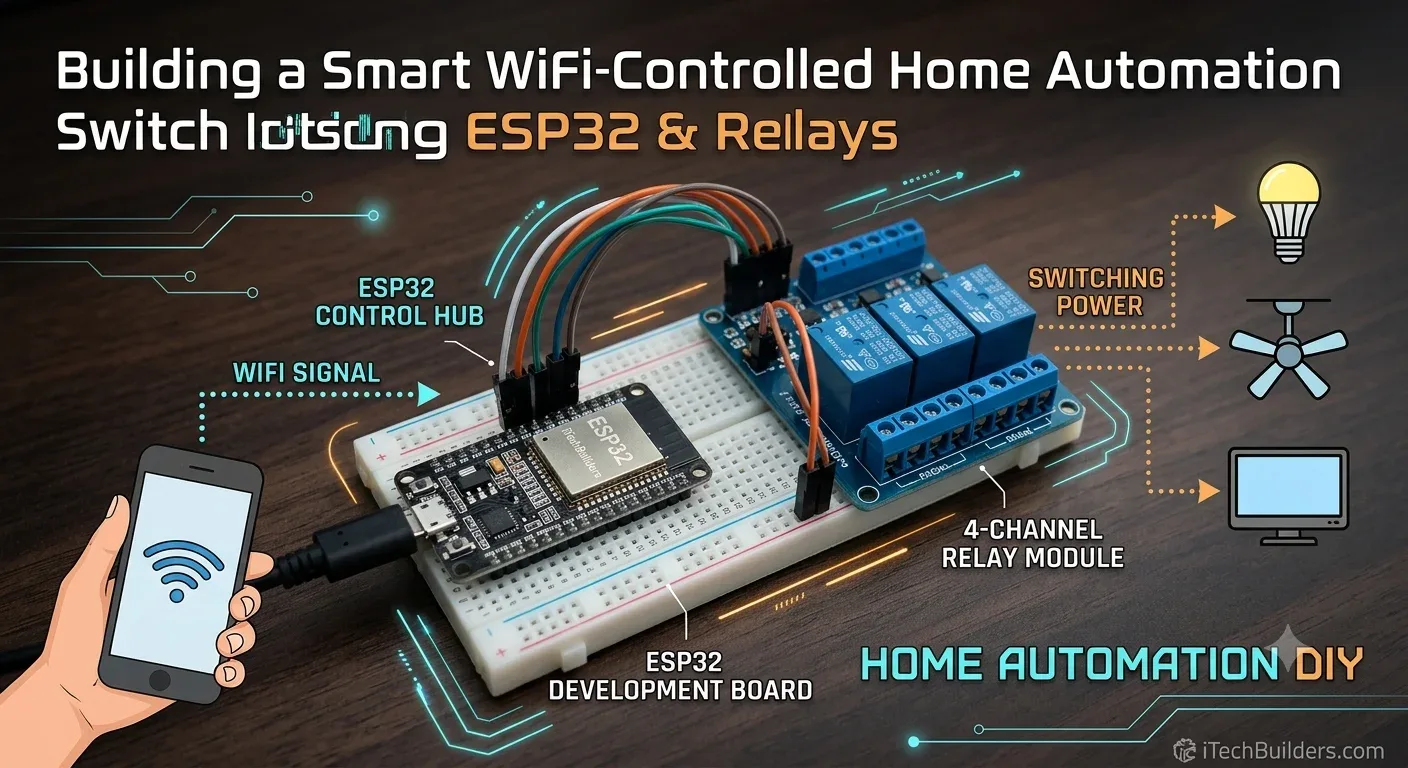
- IoT Smart Home Automation Dashboard: ESP32 Development Board + 4-Channel 5V Relay Module + 5V Power Supply.
- ESP32-CAM Wi-Fi Surveillance Camera: ESP32-CAM Board with OV2640 Module + FTDI USB-to-TTL Programmer + PIR Motion Sensor.
- ESP32-S3 Offline Voice Keyword System: ESP32-S3 Development Board + INMP441 I2S Digital Microphone + MAX98357A I2S Audio Amplifier.
- Wi-Fi OLED Desktop Weather Monitor: ESP32 Board + 0.96 inch I2C OLED Display Module.
5. 🧠 NVIDIA Jetson Nano Projects
- AI Real-Time Person & Vehicle Detection: NVIDIA Jetson Nano Developer Kit + IMX219 MIPI CSI Camera Module + 5V 4A DC Power Supply.
- Autonomous ROS SLAM Navigation Rover: NVIDIA Jetson Nano Platform + RPLIDAR A1M8 360 Laser Scanner + Encoder Motors & Heavy Metal Chassis.
- Facial Recognition Gate Attendance System: NVIDIA Jetson Nano Board + USB Wide-Angle Camera Module + 5 inch Touchscreen Display.
- Edge AI Gesture Translator: NVIDIA Jetson Nano Kit + CSI High-Speed Camera Module.
- Quality Inspection Conveyor System: NVIDIA Jetson Nano Kit + Industrial Camera Module + Conveyor Belt Assembly.
Turn Your Hardware Vision into Reality in Kanpur with #iTechBuilders
Choosing the right development board lays a solid foundation for a functional, scalable prototype. Whether you need standalone boards, project component kits, custom PCB designs, or hands-on engineering guidance in #ElectronicsStoreKanpur, iTechBuilders has you covered.
Visit iTechBuilders Store Now
Comments
0