

- 2025-09-11
- Comments
SMART HELMET (23EC008)
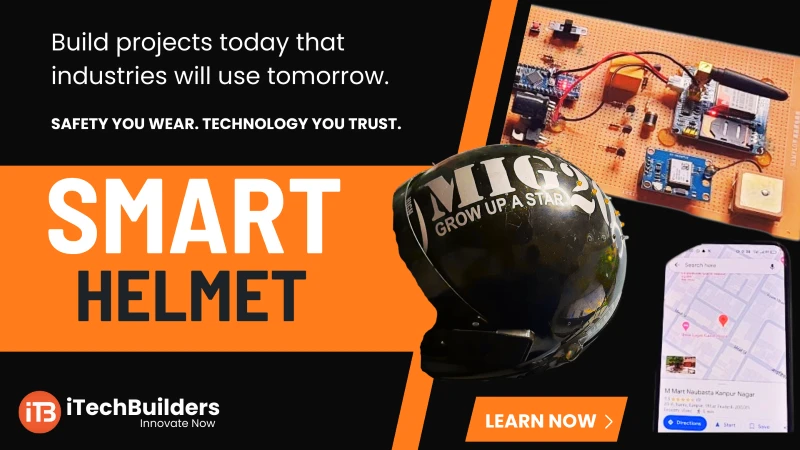
The Smart Helmet is an innovative IoT + safety project designed to improve road safety for bikers. It uses sensors and wireless communication to detect helmet usage, measure accident impact, and send alerts. With ESP32 as the controller, the smart helmet can also track location, monitor alcohol levels, and connect to IoT apps.

“A Smart Helmet ensures safety by detecting helmet usage, monitoring conditions, and sending IoT alerts in real time.”
Why Build a Smart Helmet?
- Ensures biker safety with IoT alerts
- Helmet usage detection before bike ignition
- Accident detection using impact sensors
- Location tracking via GPS + IoT cloud
- Alcohol detection with MQ-3 sensor
Key Features for Beginners
- ESP32 with Wi-Fi & Bluetooth connectivity
- Helmet wear detection using IR sensor
- Impact sensor (accelerometer) for accident detection
- GPS + IoT cloud for live tracking
- Emergency SMS/notification via IoT
Smart Helmet Working Principle
The Smart Helmet works by detecting whether the rider is wearing the helmet using an IR sensor. If not worn, the ignition remains disabled. Accident detection is done with an accelerometer/impact sensor. In case of a crash, ESP32 sends the GPS location via Wi-Fi/Bluetooth to emergency contacts or IoT dashboards.
Core Modules Used
- IR Sensor ? Helmet detection
- MQ-3 Sensor ? Alcohol detection
- Accelerometer ? Crash detection
- GPS Module ? Location tracking
- ESP32 ? IoT connectivity + processing
Quick System Specs
- Operating Voltage: 3.3V (ESP32)
- Communication: Wi-Fi, Bluetooth
- GPS Accuracy: ~2.5m
- Impact Detection: ±16g accelerometer
- Cloud Platforms: Blynk, ThingSpeak, Firebase
First Project: Helmet Wear Detection
The helmet wear detection is the first step in this project. If the helmet is not worn, the ESP32 will block ignition. If worn, it allows the system to continue.
Connections:
- IR Sensor OUT ? ESP32 GPIO 5
- VCC ? 3.3V, GND ? GND
Code:
// Smart Helmet Wear Detection
int irPin = 5;     // IR sensor input
int ledPin = 2;    // Indicator LED

void setup() {
  pinMode(irPin, INPUT);
  pinMode(ledPin, OUTPUT);
  Serial.begin(115200);
}

void loop() {
  int helmetWorn = digitalRead(irPin);
  if (helmetWorn == LOW) { // Helmet detected
    digitalWrite(ledPin, HIGH);
    Serial.println("Helmet Worn - Ignition Allowed");
  } else {
    digitalWrite(ledPin, LOW);
    Serial.println("Helmet NOT Worn - Ignition Blocked");
  }
  delay(500);
}
Learning Outcomes:
- Understand IR sensor interfacing with ESP32
- Learn how to detect helmet status digitally
- Build logic for ignition control
- Prepare foundation for accident & IoT features
Next Steps & Applications
After helmet detection, you can extend the project to accident detection, GPS tracking, alcohol monitoring, and IoT alerts. The Smart Helmet can be used for road safety, bike rental monitoring, and emergency accident response.
Get Started with Smart Helmet at iTechBuilders
iTechBuilders provides Smart Helmet kits, ESP32 tutorials, and IoT mentorship for students, schools, and innovators. Whether you want to build for safety or advanced IoT projects, we offer DIY kits, workshops, and project guidance. Contact us to kickstart your Smart Helmet project today!
