- 2025-09-11
- Comments
Arduino Uno : A Comprehensive Guide for Beginners. (25BLG101)
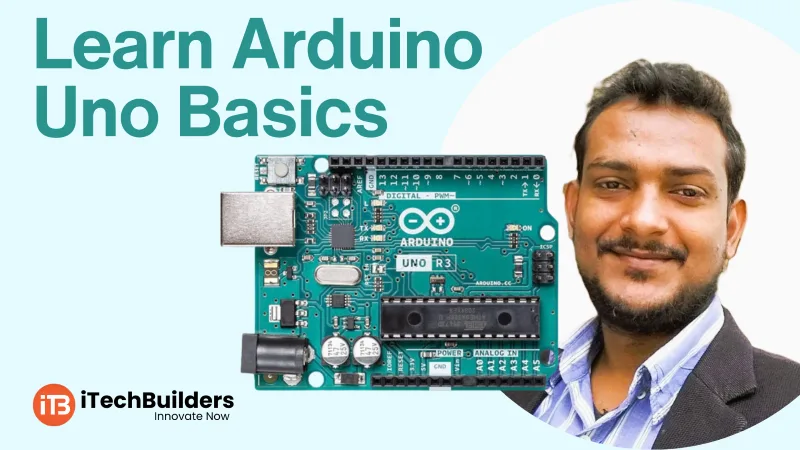
The Arduino Uno is the perfect starting point for beginners in electronics and programming. It provides a simple, affordable, and open-source platform to learn coding, hardware interfacing, and IoT. With huge community support and countless tutorials, it’s the best way to start your journey in embedded systems.

“Arduino Uno makes electronics fun, interactive, and easy to learn — perfect for beginners and future innovators.”
Why Start with Arduino Uno?
- No prior experience needed — very beginner-friendly
- Large global community with endless resources
- Learn hands-on electronics and programming together
- Supports plug-and-play projects with sensors & modules
- Affordable and available worldwide
Key Features for Beginners
- Microcontroller: ATmega328P
- Works directly with USB — easy uploading of code
- 14 Digital I/O pins (6 with PWM)
- 6 Analog input pins for sensors
- Fully compatible with Arduino IDE and C/C++
Arduino Uno Pinout Basics
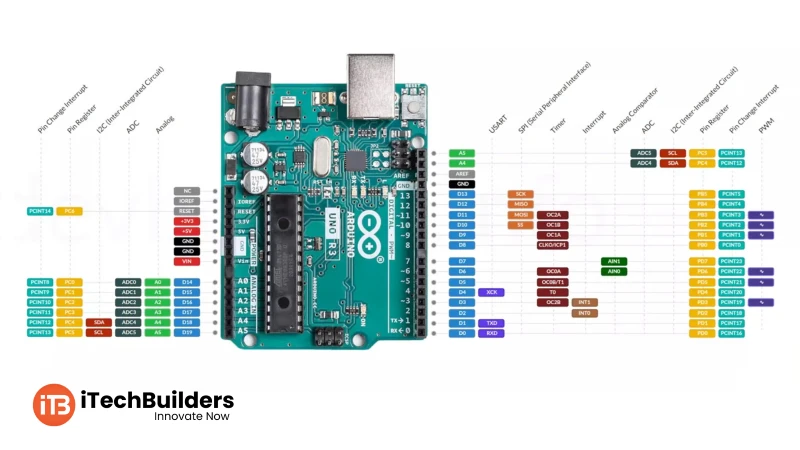
The Arduino Uno pinout lets beginners easily connect LEDs, sensors, motors, and modules. With labeled pins, it’s straightforward to understand and use.
Beginner Pin Categories
- Digital I/O: Pins 0–13
- PWM Pins: 3, 5, 6, 9, 10, 11 (for motors, LEDs)
- Analog Inputs: A0–A5 (for sensors)
- Power Pins: 3.3V, 5V, GND, Vin
- Communication: UART, SPI, I2C
Quick Pin Specs
- Max Current per I/O Pin: 20mA
- PWM Resolution: 8-bit
- ADC Resolution: 10-bit (0–1023 values)
- Clock Speed: 16 MHz
- USB Connectivity via ATmega16U2
First Project: Blink LED
The famous Blink LED is the easiest way to start with Arduino Uno. It turns an LED ON for one second and OFF for one second repeatedly.
Connections:
- Connect LED Anode (+) ? Pin 13
- Connect LED Cathode (–) ? GND via 220? resistor
Code:
 // Blink LED Example
int ledPin = 13;   // LED connected to pin 13

void setup() {
  pinMode(ledPin, OUTPUT); // Set pin as OUTPUT
}

void loop() {
  digitalWrite(ledPin, HIGH); // Turn LED ON
  delay(1000);                // Wait 1 sec
  digitalWrite(ledPin, LOW);  // Turn LED OFF
  delay(1000);                // Wait 1 sec
}
Learning Outcomes:
- Learn how to set pins as INPUT/OUTPUT
- Understand HIGH/LOW digital signals
- Get familiar with setup() and loop() structure
- Complete your first Arduino project successfully
Next Steps & Applications
After Blink, beginners can explore sensor projects (LDR, temperature, motion), motor control (PWM), and IoT projects with Wi-Fi modules. This foundation builds skills for robotics, smart devices, and IoT careers.
Get Started with Arduino at iTechBuilders
iTechBuilders offers beginner-friendly Arduino kits, step-by-step tutorials, and expert mentorship for students, schools, and hobbyists. Whether you are just starting or want to build IoT projects, we provide DIY kits, training workshops, and project support. Contact us to begin your Arduino learning journey today!